


Founded in 1589 by William V, Duke of Bavaria – has written Munich beer history and helped shape the city’s beer culture. We are proud that brewing beer the Hofbräuhaus way for over 400 years has played a role in forming the heritage of our beautiful city. The crowned HB Logo – a trademark owned by Staatliches Hofbräuhaus in München, which sells its beer under the name of Hofbräu München – is known the world over. In recent times the German beer market has undergone a consolidation process, and Hofbräu München which is in the possession of the Bavarian state, is one of the last two traditional Munich breweries still in Bavarian ownership. “Hofbräu, mein München” is a passionate declaration of our commitment to Munich, its people and the Bavarian way of life. It is our firm endeavor to continue along our path, both as a traditional Munich brewery and as an international ambassador of Munich’s art of brewing and beer culture.
Archives: Products
Hacker Pschorr
The name Hacker-Pschorr stands for a Munich brew tradition crafted over centuries, and acclaimed far beyond the borders of Bavaria throughout the entire world. As a brewer focused on quality, Hacker-Pschorr of course brews in accordance with the Bavarian Reinheitsgebot or Beer Purity Law. Our beer is sold in the popular traditional swing-top bottles.
Innis & Gunn
Innis & Gunn is a specialist independent brewing company based in Edinburgh, Scotland. Established in 2003, its beer has gone on to be the most popular British bottled beer sold in Canada, and second most popular in Sweden. It was part of the nominated drinks list for the G8 Summit 2005 at Gleneagles Hotel. The business is, since 2008, family owned following a management buy-out from its original part-owners, William Grant and Sons. Their Innis & Gunn Original beer is brewed in Dunbar, East Lothian before being matured in American white oak Bourbon barrels for 30 days and is then a further 47 days in a marrying tun, and so it is matured for 77 days in total. It is 6.6% alcohol by volume. It is available solely as a bottled beer. Due to similarities in the maturation process it is an excellent complement to most whiskies. According to Innis and Gunn’s website, the process was discovered in an ironic accident: the intent was to create a scotch whisky with ale flavours. To do this, a special beer was created which would then be stored in the whisky barrels. After the beer had conditioned the barrels, it was to be discarded and replaced with the whisky. The brewers noted that the process had an agreeable effect on the beer, and thus aging the beer became an end in itself. A “blonde” version of Innis & Gunn is also widely available, and a limited edition matured in rum barrels was produced.
Labatt Blue
Labatt Blue is the best-selling Canadian beer in the world. Introduced in 1951 as Labatt Pilsener, it was named for the colour of its label by fans of the Winnipeg Blue Bombers football team. Blue was the first brand in Canada with a twist-off cap and won the silver medal in the International Lager category at the 1998 Brewing Industry International Awards. Labatt Blue, brewed using specially selected aromatic hops, is a well-balanced, fully matured, full-flavoured beer with a fruity character and a slightly sweet aftertaste.
Modelo Especial
A rich, full-flavored pilsner beer with a slightly sweet, well-balanced taste, light hop character and crisp finish. 3.5% alcohol by weight, 4.4% alcohol by volume, 145 calories, 0 grams of fat per 12 oz. Modelo Especial has been brewed and packaged in Mexico by Grupo Modelo since 1925 and became available in the U.S. in 1990. Grupo Modelo is Mexico’s largest brewer, operating seven state-of-the-art breweries throughout Mexico.
Negra Modelo
Negra Modelo redefines the way consumers think of a dark beer because in taste and color it is a very drinkable beer. Negra Modelo appeals to import beer drinkers who are looking for something new and different. Consumers who drink craft beers also love Negra Modelo as it offers more flavor, more complexity and a little “mystery.” To achieve its unique taste, Negra Modelo uses a greater quantity of malt, the finest hops, a special yeast and the purest water. It is a delicious, creamy, full-flavored dark brew with a pleasant malt aroma and dry hop flavor that has a smooth mellow taste. 4.2% alcohol by weight, 5.4% alcohol by volume, 0 grams of fat, 170 calories per 12-oz bottle. Negra Modelo was first produced in 1926. Negra Modelo is brewed and bottled in Mexico by Grupo Modelo, Mexico’s largest brewer, operating seven state-of-the-art breweries throughout Mexico.
Ballantine
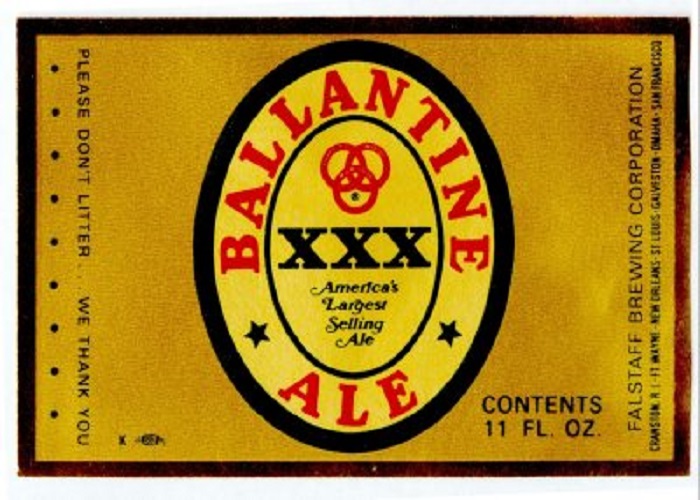
Peter Ballantine was born in Scotland on November 16, 1791 and came to seek his fortune in America in 1820. He found work at a brewery in Albany, NY and being clever and thrifty opened his own brewery there in 1833. He took his wife and three children to Newark, NJ in 1840 to be closer to the growing New York City beer market. In the beginning he leased a brewery founded by Gen. John N. Cumming but around 1850 built his own ale brewery nearby. By 1877, P. Ballantine & Sons was the fourth largest brewery in the USA and the only one brewing ales exclusively in the top 20. The famous Ballantine three ring symbol (“Purity, Body, Flavor”) was inspired by the wet rings left on a table as Peter Ballantine consumed his beer and was first used by the brewery in 1879. By the 1880s, Ballantine Brewing plants covered 12 acres and were the sixth largest brewer in America. In January of 1883 at the age of 91, Peter Ballantine passed away. The running of the brewery was passed to John H. Ballantine, and later Robert F. Ballantine.
After the death of Robert’s last son, the company was headed up by non-family members. By 1895, Ballantine was the 5th largest brewer in the country. The original ale brewery was eventually closed and all activities moved to the lager brewery site in 1912. Ballantine’s management was forward thinking and saw the coming of Prohibition. In order to allow the company to survive, they produced malt syrup and diversified into insurance and real estate. Many of the family members left to join John Ballantine at the Neptune Meter Co. Following the lifting of the Volstead Act, German brewing equipment salesman Carl Badenhausen and his brother Otto approached Ballantine to purchase the brewery. The management of Ballantine did not want to return to brewing as so many in-house skills had been lost during Prohibition. The brothers purchased the brewery and imported a brewmaster, Archibald MacKenchnie, from Scotland. Ballantine beers and ales quickly returned to their original popularity in the greater New York City area.
Ballantine had a close association with local sports. They sponsored the New York Yankees in the 1940s and 50s. N.Y. Yankee announcer Mel Allen’s called every Yankee home run a “Ballantine Blast” on his radio and later television coverage.
Colt 45
National Brewing Company introduced Colt 45 in 1963. Previously, the only major national brand of malt liquor was Country Club. The label was designed with a kicking horse and horseshoe, a subtle reference to its “extra kick” compared to competing brands. Listed on the Pabst website as a “Fun Fact”, Colt 45 was named after running back #45 Jerry Hill of the 1963 Baltimore Colts and not the pistol or the revolver.
Coors Banquet
Coors was first introduced by Adolph Coors in April 1874. It’s nicknamed the Banquet Beer, Legend has it that in the late 1800s, thirsty miners threw celebratory banquets, with Coors as the honorary beer because of its superior craftsmanship. Prior to its nationwide distribution in 1981, Coors built a cult following, with presidents, movie stars, and consumers toting the beer back from Colorado or making special trips to buy the uniquely crisp and drinkable beer. Coors is brewed in the Rockies for a uniquely crisp, clean, and drinkable “Mile High Taste.” 5.0% alcohol by volume. 149 calories per 12-ounce serving.